
Back to Sport, School, and Life After a Concussion

Kristen Johnston DPT
Physical Therapist
This is part two of a post concussion series. Start with part one here.
Most concussions resolve. The ones that drag on usually do so because someone waited, rested too long, or returned to contact too early.
Part 1 covered what a concussion looks like and what to do in the first 48 hours. This article covers what happens after that, and what physical therapy actually treats.
Where physical therapy comes in
Concussion care is a team effort. A physician or other qualified provider diagnoses the injury and gives clearance. Physical therapy treats the specific systems that stay stuck.
The neck
The force that concusses a brain also whips the neck. Neck-driven headaches and dizziness look almost identical to brain-driven symptoms, and they respond to manual therapy and targeted exercise. Current guidance recommends rehabilitation when cervicogenic or vestibular symptoms such as dizziness, neck pain, or headaches persist past 10 days.
The vestibular and visual systems
Balance and eye movement training, sometimes called vision training, addresses symptoms such as dizziness with head turns, trouble tracking a ball, and the visual fatigue that makes screens and classrooms miserable. These systems can recalibrate with the right graded exposure. They do not recalibrate with rest alone.
Exertion testing
We find the heart rate at which symptoms start, then build a program that trains just underneath it. As tolerance improves, the threshold moves up.
Current guidance supports this early. Providers with access to exercise testing can prescribe aerobic exercise below an athlete's symptom threshold as soon as 2 to 10 days after the injury, using a target heart rate set by testing. That turns a vague “take it easy” into a number the athlete can train against.
The return-to-sport progression
We run the graded steps, watch for symptom return at each stage, and hold the line when an athlete wants to skip ahead. Athletes are motivated to get back. Somebody has to be the brake.
Recovery is not waiting. Recovery is graded work with someone watching the response.
School comes before sport
For students, returning to learning takes priority over returning to play.
A concussed brain fatigues fast under cognitive load. Full days, screens, testing, and noisy hallways all cost energy. Reasonable accommodations may include shortened days, reduced screen time, extra time on assignments, rest breaks, and postponed testing.
Work with the school. Most have a protocol. Ask for it in writing.
The six-step return to play
Each step takes a minimum of 24 hours. Your PT will work with you on the appropriate speed of progression based on clinical judgement. Move up only if no new symptoms appear at the current step. If symptoms return, stop and go back to the previous step.
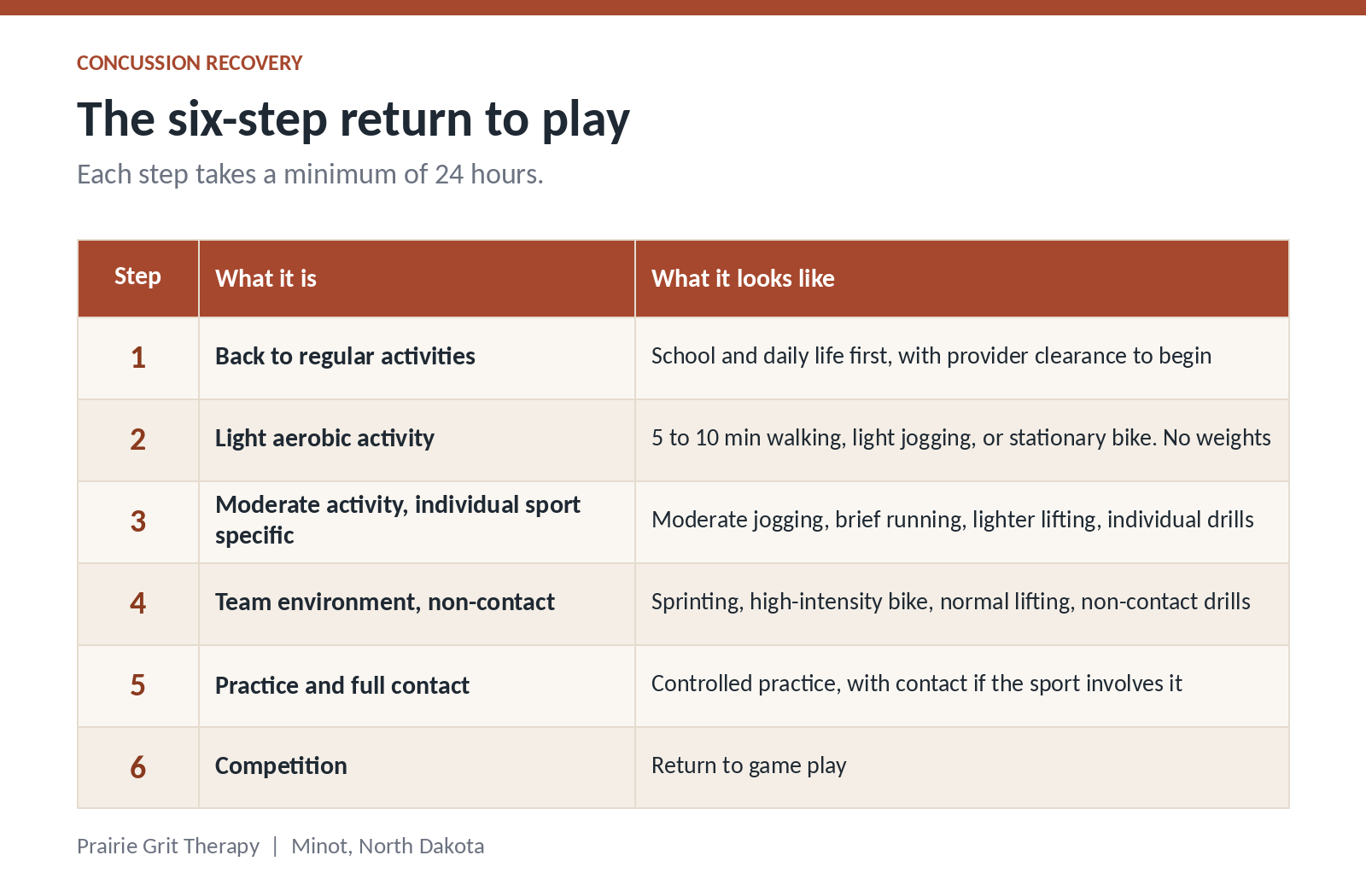
A common rule during aerobic work: stop if symptoms rise more than two points on a 0 to 10 scale compared to how you felt before you started.
When to come see us
If you are more than a week out and still fighting headaches, dizziness, neck pain, fog, difficulty tolerating light, or difficulty concentrating in class, that is not something to wait out. It is something to treat.
Request a referral and bring any paperwork or notes from the provider who evaluated you. We will build the progression from there.
Start here
Part 1: Concussion Is Not Just Being Dizzy
The first article covers the full symptom picture, why the old rest advice changed, what to do in the first 48 hours, and the danger signs that mean an emergency room visit.
Prairie Grit Therapy provides physical, occupational, and speech therapy services in Minot, North Dakota. This article is general education and does not replace evaluation by a qualified health care provider. Any athlete with a suspected concussion should be removed from play and evaluated before returning.