
Backpack Fit and Load: Get It Right in Five Minutes
Miss Sierra
Occupational Therapist
Most kids are carrying too much, and almost none of them are wearing the bag correctly.
This is a five-minute fix. Weigh the bag, adjust two straps, and take out what does not need to be there. You can do all of it tonight at the kitchen table.
Here is what we check when a family brings a backpack into the clinic.
Start with the number
The American Occupational Therapy Association recommends a packed backpack stay at or under 10 percent of the child's body weight.
Other groups set the ceiling higher. The American Academy of Pediatrics and the American Academy of Orthopedic Surgeons have both been cited in the 10 to 15 percent range, and you will find sources that go to 20 percent. That spread is real, and it is worth knowing about.
We use 10 percent. It is the most conservative widely published number; it comes from our own professional association, and for a growing kid the cost of being cautious is close to zero.
The math, already done
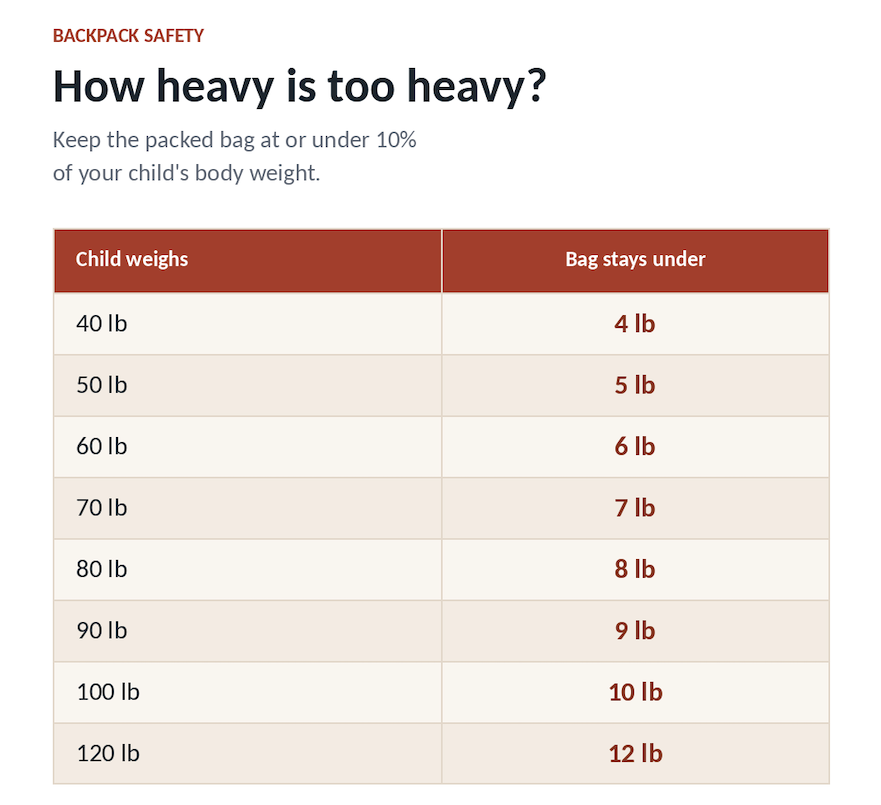
For scale: a single textbook often runs 3 to 5 pounds, and most laptops land around 3 to 5 pounds as well. Two textbooks and a laptop can put a second grader over the line before you add anything else.
How to actually weigh it
Use your bathroom scale. Two steps.
• Weigh your child. Write it down.
• Have your child hold the fully packed bag and step on the scale. Subtract.
Do this on a Wednesday, not a Monday. Monday bags are light. By midweek the folders, water bottles, gym clothes, and library books have piled up, and that is the real load your child carries.
Four fit checks
Weight is half of it. Position is the other half, and position is free.
1. Top of the pack sits 1 to 2 inches below the shoulders
Higher than that, and the straps ride into the neck. Lower and the load pulls backward.
2. Bottom of the pack rests in the curve of the low back
It should never sit more than 4 inches below the waistline. A low-riding bag drags the center of gravity backward, and your child compensates by leaning forward at the hips all day.
3. Both straps, tightened snug
One shoulder is the single most common mistake, and it is the one that changes posture and walking patterns the fastest. Tighten both straps until the bag sits flat against the back with no gap.
Wide, padded straps matter here. Roughly 2 inches of padding spreads the pressure across the shoulder instead of concentrating it on the nerves and blood vessels underneath.
4. Use the chest and waist straps if the bag has them
Most families cut these off or ignore them. They transfer load off the shoulders and onto the trunk and hips, which is exactly where you want it on a heavy day.
If you fix one thing, fix the one-shoulder habit.
Lighten the load
Once you know the number, cut down to it.
• Empty the bag completely once a week and put back only what is needed
• Swap three-ring binders for spiral or composition notebooks
• Use two 1-inch binders instead of one 3-inch binder
• Refill the water bottle at school instead of carrying it full both ways
• Ask whether the school allows locker or desk stops between classes
Rolling bags solve weight and create other problems. They are hard on stairs, they are a trip hazard in a crowded hallway, and plenty of schools do not allow them. Check before you buy one.
Signs the bag is too heavy
Watch how your child puts it on and walks away.
• Leaning forward at the hips to carry it
• Struggling to get it on or off
• Red marks or grooves on the shoulders after school
• Complaints of tingling or numbness in the arms or hands
• Back, neck, or shoulder pain, especially midweek
• A change in posture or balance while wearing it
Tingling and numbness are the ones to act on quickly. That points to pressure on the nerves and blood vessels under the straps, and it usually means the straps are too narrow, too tight, or carrying too much.
Do it tonight
Weigh the bag. Adjust the straps. Take out three things.
Five minutes now saves you a fall of complaints later. If your child is still uncomfortable after you have fixed the weight and the fit, come see us.